

- HEMP FIBER 101
Long vs Short Hemp Fiber and Where Each Is Used
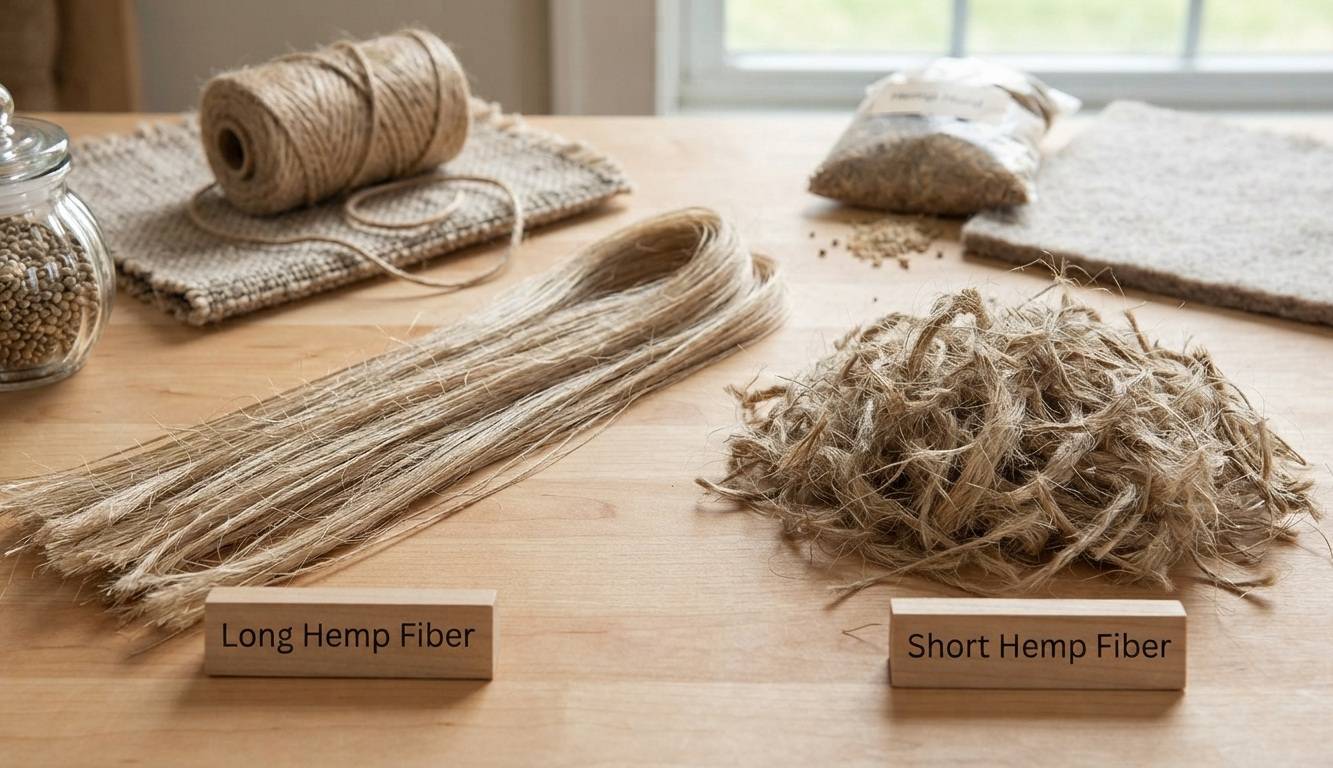
Long and short hemp fibers come from the bast portion of the hemp stalk. The main difference is easy to see - one retains greater fiber length, while the other is supplied or prepared in shorter lengths.
That difference affects how the material can be handled and where it may be useful. Longer fibers provide greater continuity and can be valuable where alignment matters. Shorter fibers can be easier to blend, distribute or incorporate into processes that don't require continuous strands.
Neither length is automatically better. The useful question is what the fiber needs to do in your project.
Hemptique carries hemp bast fiber in 3-inch, 5-inch and 7-inch lengths, giving you several starting points for textile, craft, product development and industrial applications.
Long vs Short Hemp Fiber at a Glance
| Comparison | Long Hemp Fiber | Short Hemp Fiber |
|---|---|---|
| Fiber form | Longer bast fibers | Bast fiber supplied in shorter lengths |
| Continuity | Greater fiber continuity | Less dependent on continuous strands |
| Handling | Useful where length and alignment matter | Easier to distribute, blend or process in shorter form |
| Common use areas | Spinning, textiles, cordage and aligned reinforcement | Fiber blends, composites, paper and specialty manufacturing |
| Hemptique options | 5-inch and 7-inch fiber | 3-inch fiber |
What Is Long Hemp Fiber?
Long hemp fiber consists of bast fibers that retain greater length during preparation.
Bast fibers naturally run lengthwise along the hemp stalk. Keeping more of that length intact provides continuity that can be useful in processes where fibers need to be aligned, drawn, twisted or positioned in a particular direction.
Hemptique currently offers 5-Inch Hemp Fiber and 7-Inch Long Hemp Fiber.
Fiber length alone does not determine how a material will perform. Fineness, cleanliness, alignment, processing and the requirements of the finished product also matter.
Where Is Long Hemp Fiber Used?
Long bast fiber has a long history in products that depend on fiber continuity. Modern uses also extend into textile development and natural-fiber reinforcement.
Spinning and Yarn Production
Long fibers can be aligned and drawn together during preparation for spinning. Maintaining fiber continuity helps the fibers work together as they are formed into yarn.
The exact fiber requirements depend on the spinning method. Traditional long-fiber systems work differently from short-staple systems that use shorter, more heavily refined fibers.
Textile and Fabric Production
Long hemp fiber can serve as a starting material for textile production where fiber length and alignment are important to the chosen spinning system.
The fiber first needs to be prepared and spun into yarn before that yarn can become woven or knitted fabric. The resulting textile can vary considerably depending on fiber preparation, yarn construction, blends, weave or knit structure and finishing.
This creates a direct material path:
Hemp bast fiber → Prepared fiber → Yarn → Fabric
Rope, Cordage and Twine
Hemp's long bast fibers have historically been used for rope and cordage.
Long fibers can be aligned and twisted so individual fibers work together as part of a continuous strand. Additional strands can then be combined to produce larger cordage.
Natural Fiber Reinforcement
Long hemp fibers can also be considered for composite and reinforcement applications where fiber continuity and direction are important.
In an aligned reinforcement system, longer fibers can be positioned in a chosen direction so the material benefits from their continuity along that axis.
The requirements here can be highly specific. Fiber length is only one consideration; alignment, moisture, cleanliness, compatibility with the surrounding material and manufacturing process can also affect the finished composite.
For industrial applications involving continuous fiber reinforcement, see Hemptique's Pultrusion Fiber & Yarn resource.
For engineering or production applications, always evaluate the specifications of the individual fiber before selecting it for manufacturing.
What Is Short Hemp Fiber?
Short hemp fiber is bast fiber supplied or prepared at a shorter length.
It comes from the fibrous portion of the hemp stalk, so it should not be confused with hemp hurd, which is the woody inner portion of the stalk.
Hemptique carries 3 Inch American Hemp Fiber. The shorter format can be useful when long continuous strands are unnecessary or when the fiber needs to be distributed, blended, cut or processed further.
Where Is Short Hemp Fiber Used?
Short hemp fiber opens up a different group of applications. Instead of relying primarily on long, aligned strands, these uses can take advantage of fibers that are easier to distribute throughout another material or process.
Fiber Blending
Shorter hemp fibers can be prepared for blending with compatible natural or manufactured fibers.
The appropriate length depends heavily on the equipment and final product. Textile systems designed around shorter staple fibers generally require hemp to be prepared differently from traditional long-fiber spinning.
This is also where terms such as cottonized hemp become relevant. Cottonization produces a shorter and finer hemp fiber form for short-staple processing.
For a closer explanation of cottonization and other preparation methods, see How Hemp Fiber Is Processed.
Composite Materials
Short hemp fibers can be used in composite systems where reinforcement is distributed throughout a material instead of arranged as long continuous strands.
This gives manufacturers another way to incorporate plant fiber into molded or mixed materials.
This gives manufacturers another way to incorporate plant fiber into molded or mixed materials.
The distinction is useful when comparing the basic approaches:
Longer aligned fiber can be considered where continuity and reinforcement direction matter.
Shorter fiber can be considered where fibers need to be dispersed throughout the material.
That does not mean a particular fiber length will work with every composite system. Resin or binder compatibility, fiber preparation, moisture, fiber loading, manufacturing method and required performance all need to be evaluated.
Product Development and Manufacturing
Short hemp fibers can also be considered for products where natural fibers are incorporated into another material, used as filling or processed into a different fiber-based form.
These applications vary widely, so buyers should start with the requirements of the finished product rather than selecting fiber based on length alone.
For product development, useful questions include:
Does the fiber need to remain aligned?
Will it be blended with another fiber or material?
Does the manufacturing equipment have a maximum usable fiber length?
Will the fiber be cut or refined further?
How consistently does the fiber need to disperse?
What level of cleanliness and refinement does the process require?
These questions can help determine whether a longer or shorter starting fiber makes sense.
Paper and Fiber-Based Products
Paper production does not require fibers to remain as long continuous strands in the way traditional long-fiber spinning does.
Hemp fiber can be broken down and prepared for pulp and other fiber-based materials, making shorter fibers relevant to this category.
The properties required for paper also differ from those required for yarn, textiles or composites, so fiber length is only one part of material selection.
For a closer look at this application, read What Is Hemp Paper.
Does Longer Hemp Fiber Mean Better Hemp Fiber?
Fiber length is a specification, not a quality ranking.
A 7-inch hemp fiber provides greater length than a 3-inch fiber, but that advantage matters only if the application benefits from longer fibers.
A shorter fiber may be easier to blend or distribute through another material. It may also fit processing equipment that cannot readily handle longer bast fibers.
Conversely, cutting a long fiber into short pieces would remove the continuity that made the longer material useful in the first place.
This is why the intended use should determine the fiber length you choose.
Choosing Hemp Fiber Length by Application
Use this chart as a starting point rather than a technical specification for a particular manufacturing process.
| Application | Fiber Length to Consider | Why |
|---|---|---|
| Long-fiber spinning | Longer fiber | Preserves continuity for alignment and yarn preparation |
| Textile development | Depends on the spinning system | Long-fiber and short-staple systems require different fiber preparation |
| Rope and cordage | Longer fiber | Fiber continuity supports alignment and twisting into strands |
| Aligned reinforcement | Longer fiber | Useful where reinforcement direction and continuity matter |
| Distributed composite reinforcement | Shorter fiber | Easier to distribute throughout a material |
| Paper and pulp applications | Shorter fiber may be suitable | Continuous aligned strands aren't required |
For commercial manufacturing, use this comparison to narrow your options, then review the specifications and processing requirements for your particular application.
Choose Fiber Length Based on What Happens Next
Long and short hemp fibers serve different purposes.
Longer bast fibers provide greater continuity and can be useful for spinning, cordage, textile development and applications that rely on fiber alignment. Shorter bast fibers can be easier to blend, distribute or incorporate into processes where continuous strands aren't required.