A universal needle may work with lighter hemp canvas, particularly when sewing only a few layers. For dense or heavyweight canvas, a jeans or denim needle is generally a better starting choice. Test the needle on the actual fabric before sewing the project.


How to Sew Hemp Canvas: Needles, Seams & Heavyweight Sewing Tips
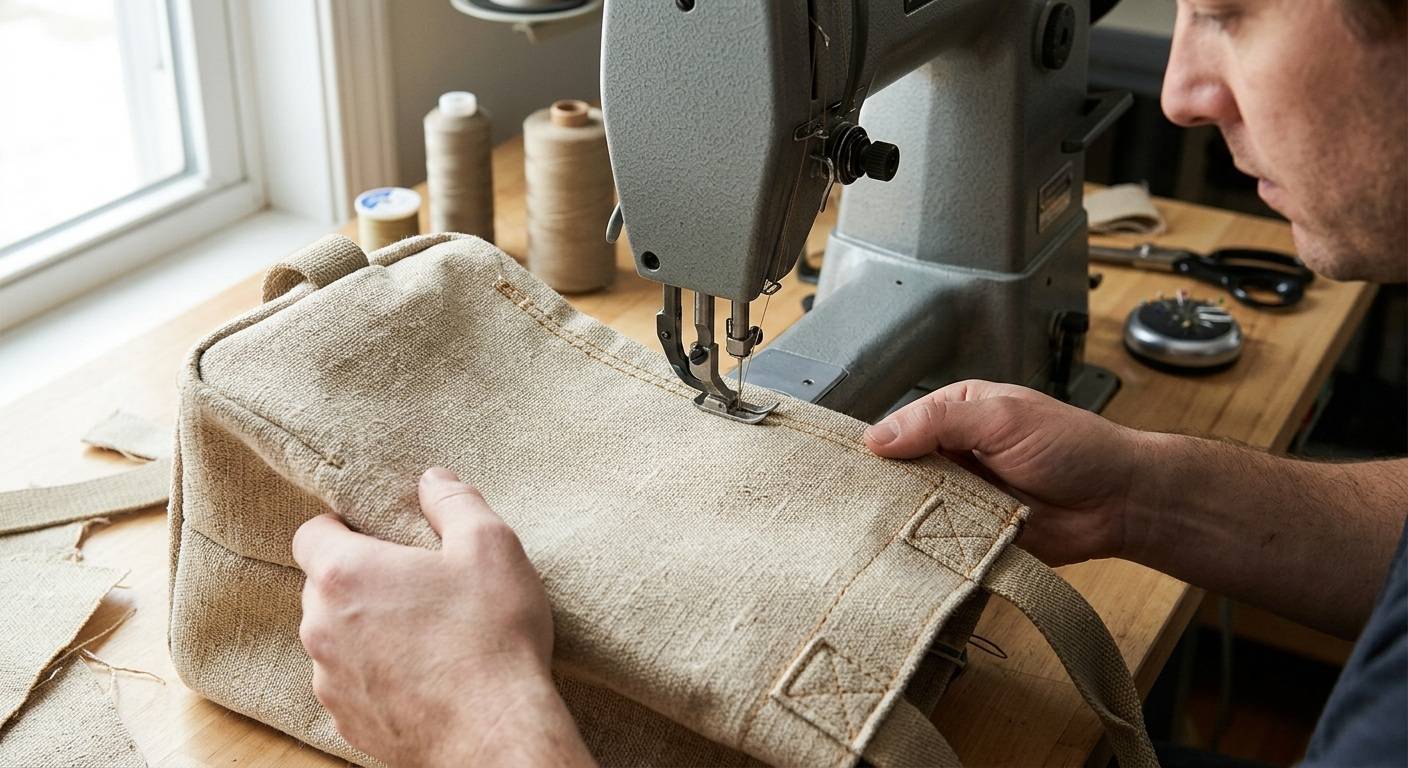
Hemp canvas is a durable woven fabric used for tote bags, aprons, organizers, workwear and other structured sewing projects. Its dense construction makes it useful for items that need to hold their shape, but sewing thick layers can be challenging on a regular sewing machine.
Learning how to sew hemp canvas starts with choosing the right needle and thread, adjusting stitch settings, and planning seams to reduce unnecessary bulk. These techniques help prevent broken needles, skipped stitches, uneven feeding, and weak seams.
New to sewing with hemp? Start with our How to Sew Hemp Fabric guide for general advice on preparing, cutting, stitching, and finishing woven and knit hemp fabrics. This article focuses specifically on sewing heavyweight hemp canvas and managing thick seams.
Table of Contents:
Can You Sew Hemp Canvas on a Regular Sewing Machine?
Choose the Right Hemp Canvas Weight
Best Needles, Thread and Stitch Settings for Hemp Canvas
How to Prepare and Cut Hemp Canvas
How to Sew Hemp Canvas Step by Step
How to Reduce Bulk When Sewing Thick Hemp Canvas
Strong Seams and Reinforcement for Hemp Canvas Projects
Common Problems When Sewing Hemp Canvas
Hemp Canvas Sewing Project Ideas
Can You Sew Hemp Canvas on a Regular Sewing Machine?
Yes, many home sewing machines can handle hemp canvas, particularly lighter and medium-weight varieties. The main limitation is usually the thickness of the fabric layers at folded hems, corners, and seam intersections.
A machine may sew two layers of canvas without difficulty but struggle when those layers are folded into six or eight layers at a bag handle or corner.
Before starting a project, check your machine's manual for recommended needle sizes, thread weights, and fabric limitations.
Test the thickest part of your planned construction using scraps of the actual canvas. If the machine struggles to feed the material, the needle bends, or the motor strains, stop and reduce the thickness or change the construction.
A heavy-duty machine may offer greater capacity, but the label alone does not establish how many layers it can sew.
Choose the Right Hemp Canvas Weight
Hemp canvas is available in different weights and finishes. The heavier the fabric, the greater the potential for bulky seams, although weave density and stiffness also affect sewing difficulty.
| Canvas Weight | Approximate GSM | Sewing Considerations |
|---|---|---|
| 7–10 oz/yd² | 237–339 GSM | Often suitable for lighter bags, aprons, and structured accessories |
| 10–12 oz/yd² | 339–407 GSM | Useful for firmer projects; folded seams require testing |
| 12–16+ oz/yd² | 407–542+ GSM | Dense or stiff varieties may challenge domestic machines |
These ranges are general guidelines, not fixed industry classifications. Two fabrics with the same weight can behave differently because of their weave, finishing, and fiber composition.
For a first canvas project, choose a weight your sewing machine can handle comfortably. A lighter canvas may provide sufficient structure without creating difficult seam intersections.
If you are still deciding between woven, knit, and canvas fabrics, see Hemptique's Hemp Knit Fabrics and Canvas Guide.
Explore Hemptique's Hemp Fabric Collection to compare available fabrics for sewing projects. Check each product's weight, composition, width, and finish before selecting a material for bags, aprons or other structured items.
Best Needles, Thread and Stitch Settings for Hemp Canvas
The correct setup depends on the canvas weight, number of layers, thread thickness and machine capabilities.
Choosing a Needle for Hemp Canvas
A jeans or denim needle is a useful starting choice for dense woven hemp canvas. These needles are designed to work through tightly woven fabrics and are available in several sizes.
| Canvas Construction | Starting Needle Size | Suggested Stitch Length |
|---|---|---|
| Lighter canvas, two layers | Jeans 90/14 | 3 mm |
| Medium-weight canvas | Jeans 90/14–100/16 | 3–3.5 mm |
| Heavy canvas or bulky intersections | Jeans 100/16, if supported by the machine | 3–3.5 mm |
These settings should be tested on the actual material. Very thick fabric assemblies may exceed a domestic machine's capacity regardless of needle size.
The needle sizes and stitch lengths in this table are starting recommendations, not fixed settings for every canvas project. The correct combination depends on the fabric's thickness, weave, number of layers, thread, and sewing machine. Always check your machine's supported needle sizes and test the settings on scraps that match the thickest part of your project.
A fresh needle is important. If stitches become uneven or the needle begins to deflect, inspect it before continuing.
Avoid using a leather needle as a default substitute. Leather needles have cutting points intended for leather and certain nonwoven materials, which can damage woven fabric threads.
Choosing Sewing Thread for Hemp Canvas
Cotton and linen are natural-fiber thread options for appropriate hemp canvas projects.
Cotton sewing thread can work for general construction, provided the thread has sufficient strength for the project and is compatible with the needle and machine.
Linen thread may be useful for hand stitching, decorative work, and certain structured applications. For machine sewing, select linen thread specifically manufactured for that purpose. Craft, bookbinding, or heavy hand-sewing linen thread may be unsuitable for a domestic sewing machine.
For bags and other projects exposed to repeated pulling or abrasion, stronger synthetic sewing threads may also be appropriate. Select thread based on the finished item's requirements, not fiber content alone.
Very thick thread can cause tension problems or exceed the capacity of the machine's needle and bobbin system. Always check compatibility before purchasing heavy-duty thread.
Adjusting Stitch Length and Tension
For hemp canvas, begin with a straight stitch approximately 3–3.5 mm long.
A slightly longer stitch can improve feeding and reduce excessive needle perforations in dense fabric. However, excessively long stitches may be unsuitable for short seams, curves, or areas requiring reinforcement.
Begin with your machine's normal thread tension setting and inspect the test seam.
The upper and bobbin threads should form balanced stitches without loose loops, puckering, or visible tension problems. If adjustment is necessary, change one setting at a time.
How to Prepare and Cut Hemp Canvas
Prewash When Appropriate
Untreated, washable hemp canvas may shrink during its first wash. Prewashing before cutting can help prevent unexpected size changes in finished projects.
Follow the fabric supplier's care instructions. Some coated, waxed or specially finished canvas should not be washed or pressed using ordinary methods.
Finish raw edges if needed.
Wash according to the recommended care method.
Dry the fabric appropriately.
Press it if the finish permits.
Allow it to cool and lie flat before cutting.
If you are making an item that will be washed regularly, prepare the fabric using a care method compatible with the finished item.
Cut Heavy Canvas Accurately
Use sharp fabric shears or a rotary cutter rated for the material's thickness.
Lay the fabric flat without pulling it out of shape. Follow the pattern's grainline markings and keep pieces aligned with the weave.
For particularly thick canvas, cutting a single layer at a time can produce more accurate edges than folding the material.
Mark handle placements, pocket positions, seam allowances, and reinforcement points before assembling the project.
Sewing clips are often easier to use than pins for holding thick layers together.
What About Waxed or Coated Hemp Canvas?
Waxed and coated canvas require additional care because their surface finishes can affect cutting, stitching, and pressing.
Waxed canvas may retain visible pinholes, so sewing clips are often preferable to pins. Avoid unnecessary stitching or repeated seam removal, which can leave permanent marks.
Heat can soften or redistribute wax, while some coatings may be damaged by pressing. Follow the fabric manufacturer's instructions and test any pressing method on a scrap.
Waxed or coated canvas should not automatically be treated like untreated, washable hemp fabric. Check the recommended cleaning and care methods before beginning the project.
How to Sew Hemp Canvas Step by Step
Step 1: Test the Thickest Fabric Layers
Before constructing the project, assemble a sample that matches its thickest seam intersection.
For example, if a tote bag handle will be attached over a folded upper edge, test the same number of layers, thread, and stitch arrangement.
A successful test on two flat layers does not establish that the machine can sew every part of the finished project.
Step 2: Align and Secure the Pieces
Match the fabric edges and pattern markings. Use sewing clips to hold the layers in place.
If the project includes handles or straps, check their alignment before stitching. Uneven placement can be difficult to correct after several layers have been sewn together.
Support large fabric pieces on the sewing table so their weight does not pull against the needle.
Step 3: Sew Slowly and Guide the Fabric
Position the canvas under the presser foot and lower the foot completely.
Begin sewing at a controlled speed, guiding the fabric without pulling it through the machine.
Allow the feed dogs to advance the material. Pulling from behind the needle can bend the needle, distort the seam, or damage the machine.
If the upper and lower layers shift, a compatible walking foot may help them feed more evenly.
Step 4: Manage Thick Seam Intersections
Slow down as the presser foot approaches a thick seam intersection. If the foot begins to tilt, stop with the needle lowered into the fabric and raise the presser foot.
Place a compatible presser-foot leveling tool, sometimes called a hump jumper, under the rear of the foot, keeping it clear of the needle's path. Lower the foot and check that it sits approximately level.
Continue sewing slowly. Depending on the tool and seam construction, you may need to reposition the support under the front of the foot as it moves down from the raised section. Follow the tool manufacturer's instructions.
A leveling tool helps the fabric feed evenly; it does not increase the machine's ability to penetrate thick material. Stop if the needle bends, the machine strains, or the fabric cannot advance smoothly.
Step 5: Secure the Seam
For ordinary construction seams, backstitch where appropriate to secure the ends.
Areas subject to pulling, such as tote bag handles, may require additional reinforcement.
Reinforcement should be planned as part of the pattern, with stitch placement and thread strength appropriate for the intended use.
Step 6: Press and Inspect
Press completed seams if the fabric finish permits.
Check for skipped stitches, uneven tension, distorted edges, and sections where the layers have shifted.
How to Reduce Bulk When Sewing Thick Hemp Canvas
Seam bulk is one of the main challenges in heavyweight canvas sewing. Several layers can accumulate where hems, side seams, handles and corners overlap.
Grade Seam Allowances
Grading means trimming enclosed seam allowances to different widths so their edges do not form one thick ridge.
For example, an enclosed seam with two allowances may be easier to turn if one allowance is trimmed shorter than the other.
Only grade areas where the pattern and seam construction permit it. Avoid removing fabric needed for seam strength.
Trim Corners Carefully
When turning a structured bag or accessory, thick corners can form lumps.
Trimming excess allowance near a corner can help the finished shape lie flatter. Leave sufficient fabric beyond the stitching so the corner remains secure.
Plan the Construction Before Sewing
Sometimes the easiest way to manage bulk is to prevent it.
Consider the order of assembly, the placement of folded edges, and whether certain seams can be finished before additional layers are attached.
A pattern specifically developed for heavyweight canvas is a useful starting point.
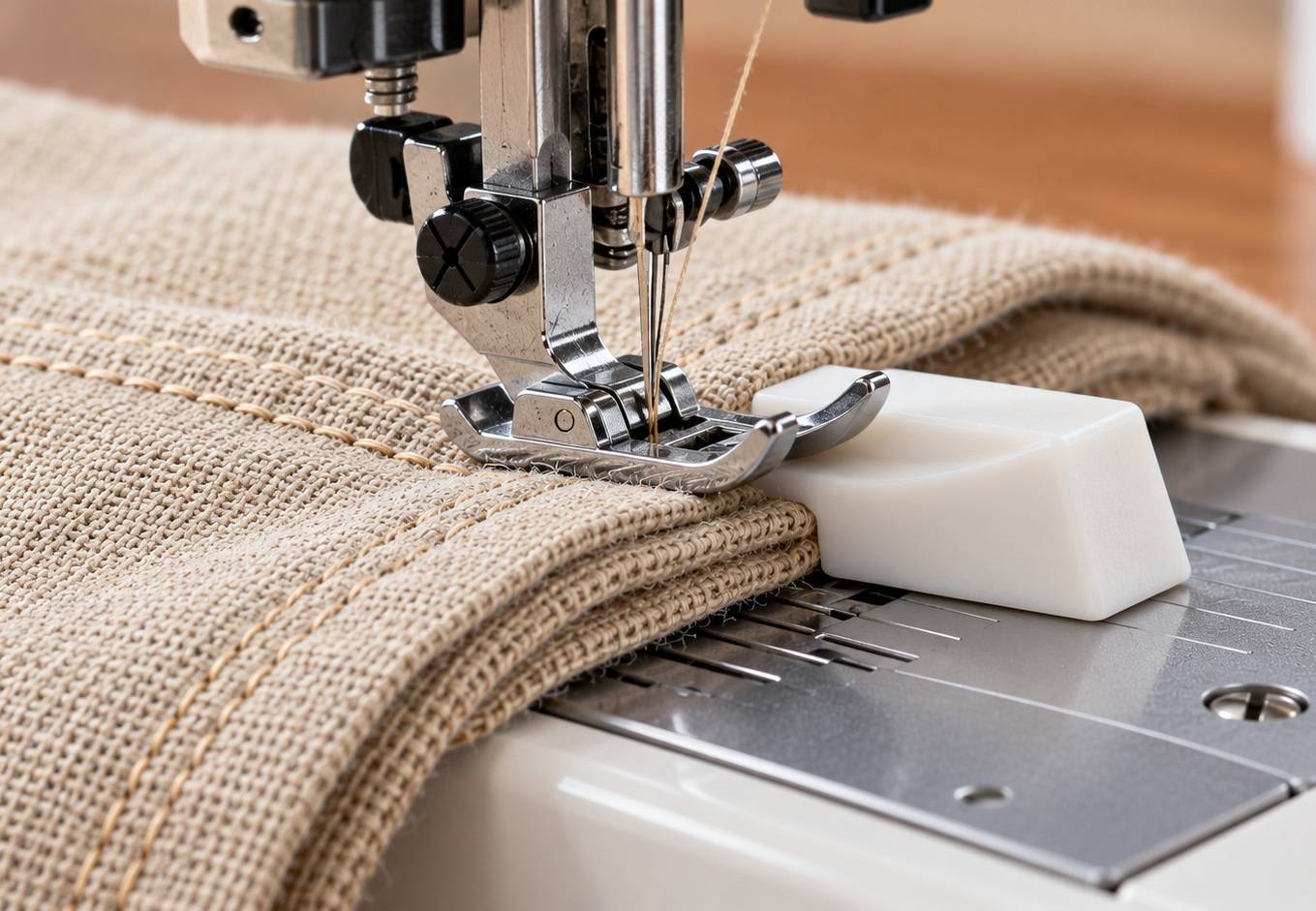
Sewing through multiple layers of heavyweight woven fabric
Use a Presser-Foot Leveling Tool
A leveling tool can be especially helpful where a thick folded seam meets a flatter section.
By supporting the presser foot, it can improve fabric feeding and reduce skipped stitches at the transition.
The tool does not increase the machine's piercing capacity. If the fabric remains too thick, reduce the number of layers or revise the seam.
Strong Seams and Reinforcement for Hemp Canvas Projects
The appropriate seam depends on the item's construction and how it will be used.
| Seam or Technique | Common Application | Consideration |
|---|---|---|
| Plain seam with finished allowances | Bags, aprons, accessories | Simple construction; raw edges need attention |
| Topstitched seam | Structured panels and visible details | Helps hold allowances in position |
| Flat-felled seam | Selected workwear and utility projects | Encloses raw edges but adds thickness |
| Bound seam | Exposed interior bag seams | Covers raw edges without folding the canvas repeatedly |
| Box-X or other reinforced attachment | Bag handles and straps | Must be designed for the expected load |
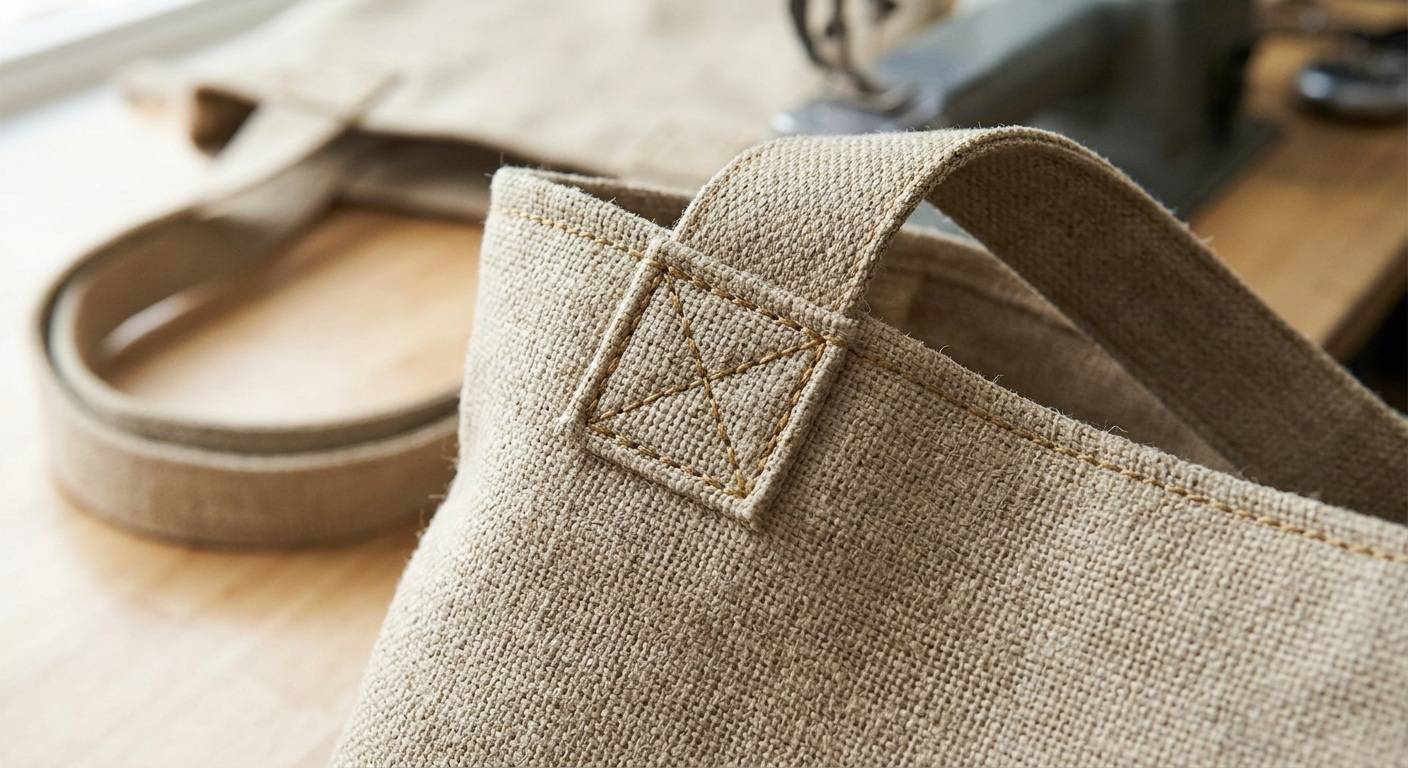
Reinforcing Tote Bag Handles
Handles are often exposed to repeated pulling, especially when a bag carries heavy items.
One common reinforcement method is Box-X stitching. The stitching forms a rectangle around the handle attachment area, with two diagonal lines crossing inside it to create an X.
For example, a tote bag pattern may position the end of a fabric handle against the bag's upper panel and secure it using a Box-X pattern. This distributes stitching across the attachment area instead of concentrating it along one straight line.
The dimensions and placement of the reinforcement should follow a suitable bag pattern. The strength of the attachment depends on the fabric, thread, stitch formation, seam allowances, and overall construction.
Avoid assuming that adding more stitches automatically creates a stronger connection. Excessive stitching can perforate the material, particularly when concentrated in a small area.
Box-X stitching is a common handle-attachment method, but its appearance alone does not establish the strength of the finished bag. Handle material, thread strength, stitch placement, fabric condition, and the surrounding construction all affect performance. For bags intended to carry substantial weight, follow a tested pattern with appropriate reinforcement.
Finishing Raw Canvas Edges
Hemp canvas is woven and may fray along cut edges.
For interior seams, a zigzag or overlock finish can help control fraying. Binding may be useful where a clean interior appearance is important.
French seams are generally less practical for very thick canvas because they require additional folds. Flat-felled seams can also become bulky at intersections.
Choose a finish that protects the edges without exceeding the machine's capacity.
For step-by-step instructions on zigzag stitching, overlocking, binding, and enclosed seams, see our How to Stop Hemp Fabric From Fraying guide.
Common Problems When Sewing Hemp Canvas
| Problem | Possible Cause | What to Try |
|---|---|---|
| Needle breaks | Too many layers, incorrect needle, pulling fabric | Stop, reduce bulk, check needle size and machine capacity |
| Skipped stitches | Bent needle, incorrect needle, uneven foot position | Replace needle and test a leveling tool |
| Fabric will not feed | Excessive thickness, foot pressure, project weight | Support fabric, inspect settings, reduce layers |
| Thread breaks | Needle/thread mismatch, threading problem | Rethread and check thread compatibility |
| Uneven stitches | Inconsistent feeding or tension | Test on matching scraps and adjust one setting |
| Bulky corners | Stacked seam allowances | Grade or trim allowances where appropriate |
| Fraying seam edges | Unfinished woven edges | Zigzag, overlock, or bind the allowances |
If the machine repeatedly stalls, makes unusual noises, or struggles to move the needle through the material, stop sewing. Continuing can damage the needle or machine.
Hemp Canvas Sewing Project Ideas
Hemp canvas is useful for projects where structure and abrasion resistance are important.
Tote bags: A practical choice for learning how to attach handles, sew corners, and reinforce stress points.
Utility aprons: Useful for practicing pockets, straps, and topstitching.
Fabric organizers: Small baskets, tool rolls, and storage accessories offer opportunities to work with structured panels.
Cushion covers: Suitable canvas weights can be used for durable household accessories, provided the fabric's hand and finish are appropriate.
Workwear accessories: Selected canvas weights can be used for tool pouches and other utility items when the construction meets the intended demands.
Before starting, compare the fabric weight and thickness with your pattern and sewing machine capabilities.
Shop Hemp Fabrics for Sewing at Hemptiquevas Sewing Project Ideas
Hemptique offers natural hemp fabrics and hemp blends for sewing, crafting and DIY projects. Our fabric selection provides options for makers working on clothing, bags, accessories, and home projects.
Browse the collection to compare available fabric weights, compositions and textures. For structured projects such as tote bags, organizers, and utility aprons, choose a fabric with the weight and firmness your pattern requires.
Frequently Asked Questions
Can You Sew Hemp Canvas With a Universal Needle?
Can You Use a Regular Presser Foot for Hemp Canvas?
Yes. A standard presser foot can work for many hemp canvas projects if the machine feeds the fabric evenly. A compatible walking foot may help when layers shift, while a leveling tool can assist at thick seam intersections.
Can You Sew Hemp Canvas Without a Heavy-Duty Sewing Machine?
Yes, many regular sewing machines can sew lighter or medium-weight hemp canvas. Very thick canvas and multiple folded layers may require a more capable machine. Test the thickest planned seam before starting.
Can You Use Cotton Thread to Sew Hemp Canvas?
Yes, suitable cotton sewing thread can be used for many projects. For items exposed to heavy loads or repeated abrasion, choose thread based on the required strength and construction.
Should You Prewash Hemp Canvas Before Sewing?
Prewash untreated, washable hemp canvas when appropriate for the finished project's care requirements. Always check the supplier's instructions first, particularly for coated, waxed or specialty-finished fabrics.
How Do You Stop Hemp Canvas From Fraying?
Finish exposed seam allowances using zigzag stitching, overlocking, binding, or an enclosed seam where the fabric thickness permits. The most suitable method depends on the project and number of layers.
Sewing Tips and Safety Note
The techniques, needle sizes, stitch settings, and fabric preparation methods in this guide are general recommendations. Results may vary depending on the hemp fabric's weight, weave, composition, finish, and the sewing machine being used.
Always check your fabric's care instructions and your sewing machine manufacturer's recommendations. Test stitches and seam finishes on fabric scraps before starting your project. Never force thick fabric through a sewing machine if the needle or motor is struggling.
For projects requiring specific strength, durability, or load-bearing performance, use a suitable tested pattern and construction method.