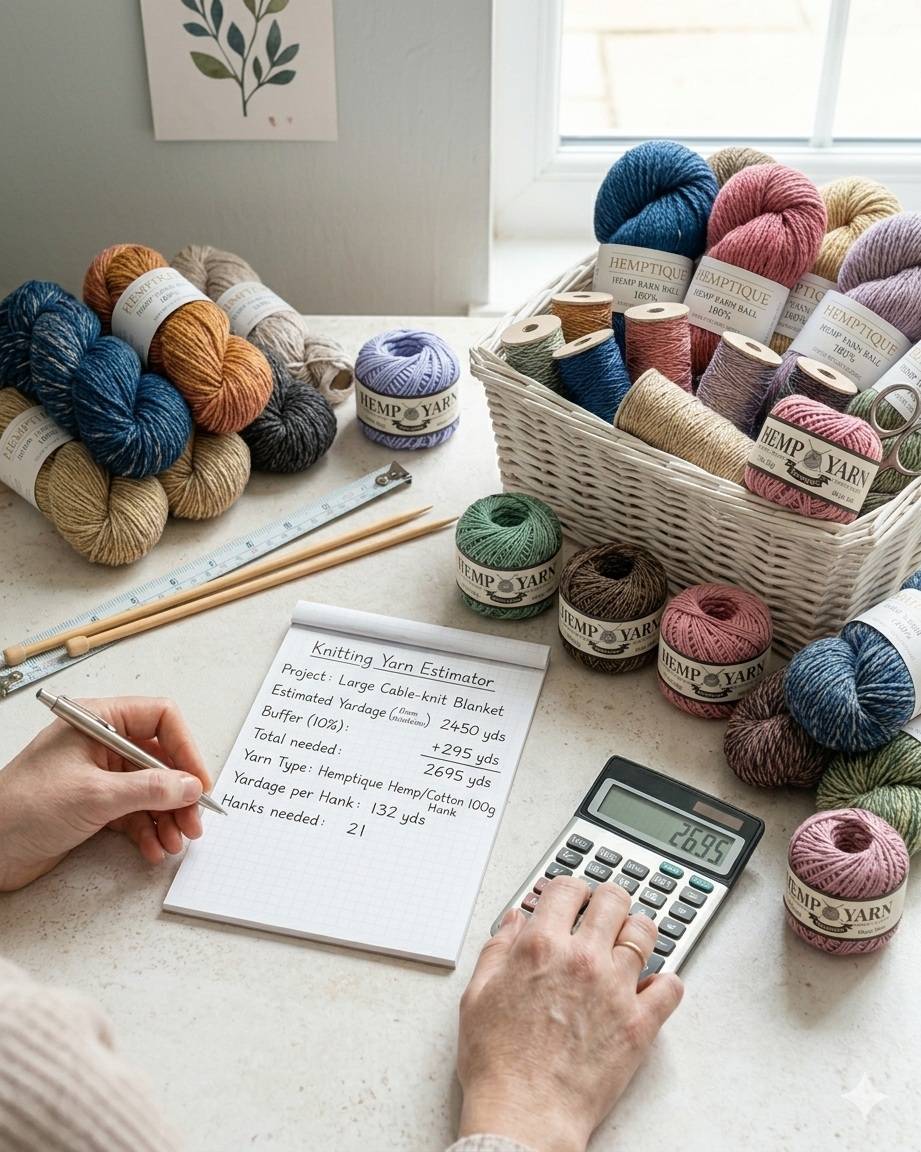
A baby blanket may need around 900–1,800 yards. A throw blanket may need 1,800–3,500 yards or more, depending on size, gauge and stitch pattern.


Knitting Yarn Calculator: Estimate Yarn, Skeins and Yardage
Calculate How Much Yarn Your Knitting Project Needs Before You Start
Running out of yarn before finishing a knitting project can throw off your entire plan, especially for larger pieces like blankets, sweaters, cardigans and scarves. Buying too much can also leave you with extra skeins you may not use.
This knitting yarn calculator helps estimate how much yarn you need based on project size, stitch density, gauge and yarn format. It also shows estimated balls or hanks needed using Hemptique hemp yarn options, so you can plan materials before you cast on.
Table of Contents:
How Much Yarn Do You Need for Knitting?
Why No Knitting Yarn Calculator Can Be Exact
How the Knitting Yarn Calculator Works
Recommended Yarn for Knitting Projects
Typical Yarn Usage by Knitting Project
What Affects Knitting Yarn Usage?
What Are Common Mistakes When Estimating Knitting Yarn
How to Estimate Knitting Yarn More Accurately
Knitting vs Crochet Yarn Usage
Knitting Yarn Calculator
Estimate yarn, skeins, hanks and retail material cost for your knitting project.
Estimated Yarn Needed
Total yards—
Total meters—
Recommended Hemptique Yarn Formats
Hemp Yarn Ball 50g
66 yds / 60m per ball
Quantity needed—
Estimated retail material cost—
Hemp Yarn Twisted Hank 100g
132 yds / 120m per hank
Quantity needed—
Estimated retail material cost—
This calculator gives a practical estimate. Actual yarn usage may vary depending on tension, needle size, stitch pattern, blocking, edging and project changes. Estimated retail cost is based on current listed product pricing before discounts, taxes or shipping. Actual price may vary.
How Much Yarn Do You Need for Knitting?
The amount of yarn you need for knitting depends on several factors:
finished project size
- yarn weight
- stitch pattern
- knitting gauge
personal tension
As a general rule, larger projects, tighter stitches and textured patterns use more yarn. Simple scarves may only need a few hundred yards, while blankets, sweaters and cardigans can require well over 1,000 yards.
For the most accurate estimate, make a gauge swatch first. If you do not have a swatch, use the quick estimate mode in the calculator as a planning starting point.
Why No Knitting Yarn Calculator Can Be Exact
No knitting yarn calculator can be mathematically exact because knitting is affected by human variation.
Two knitters can use the same yarn, needles and pattern but still use different amounts of yarn because of:
Two knitters can use the same yarn, needles and pattern but still use different amounts of yarn because of:
tension
- stitch tightness
- needle size
- stitch pattern
- row height
- blocked dimensions
- edging, ribbing or borders
- yarn texture and fiber behavior
That is why a yarn calculator should be used as an estimate, not a guarantee.
The most accurate method is to knit a small swatch, measure how much yarn it used, then scale that amount to the full project size. This calculator includes both a quick estimate mode and a swatch-based mode for better planning.
The most accurate method is to knit a small swatch, measure how much yarn it used, then scale that amount to the full project size. This calculator includes both a quick estimate mode and a swatch-based mode for better planning.
How the Knitting Yarn Calculator Works
The calculator uses two methods.
Quick Estimate Mode
Use this if you do not have a swatch. It estimates yarn based on:
- project type
- finished width and length
- stitch density
- safety buffer
- yarn format
This is helpful for early planning, comparing project sizes or estimating how many skeins you may need before choosing a final pattern.
Swatch Calculator Mode
Use this if you already made a knitting swatch.
Total yarn needed = project area ÷ swatch area × yarn used in swatch.
Then the calculator adds your selected safety buffer.
Recommended Yarn for Knitting Projects
Hemptique’s hemp yarns are a practical option for knitting projects that need structure, breathability and natural fiber content.
| Product | Size | Length | Needles | Gauge | Price |
|---|---|---|---|---|---|
| Hemp Yarn Balls | 50g | 66 yds / 60m | 5mm / US 8 / UK 6 | 16 sts / 10cm, 22 rows | $6.99 |
| Hemp Yarn Twisted Hank | 100g | 132 yds / 120m | 5mm / US 8 / UK 6 | 16 sts / 10cm, 22 rows | $11.99 |
Use the 50g balls for smaller projects, colorwork, accessories or projects where you want more color flexibility.
Use the 100g twisted hank for larger pieces like scarves, shawls, blankets and lightweight garments where fewer joins are helpful.
Use the 100g twisted hank for larger pieces like scarves, shawls, blankets and lightweight garments where fewer joins are helpful.
Typical Yarn Usage by Knitting Project
These ranges are estimates. Cables, ribbing, seed stitch, colorwork, borders and tighter gauge can increase yarn usage.
| Knitting Project | Typical Yardage Range |
|---|---|
| Dishcloth / washcloth | 60–120 yds |
| Hat | 150–350 yds |
| Scarf | 300–700 yds |
| Shawl | 600–1,500 yds |
| Baby blanket | 900–1,800 yds |
| Throw blanket | 1,800–3,500 yds |
| Lightweight top | 800–1,600 yds |
| Sweater | 1,200–2,500 yds |
| Cardigan | 1,500–3,000 yds |
These ranges are estimates. Cables, ribbing, seed stitch, colorwork, borders and tighter gauge can increase yarn usage.
What Affects Knitting Yarn Usage?
Stitch Pattern
Different knitting stitches use different amounts of yarn. Examples:
stockinette stitch → standard usage
- garter stitch → often uses more yarn because every row creates ridges
- rib stitch → can use more yarn due to stretch and compression
- seed stitch → higher usage because of dense texture
- cables → higher usage because stitches cross and pull fabric inward
- colorwork → may require extra yarn for floats and color changes
If your project includes cables, dense texture or heavy ribbing, add extra yarn.
Gauge
Gauge measures how many stitches and rows fit into a set area. If your gauge is tighter than expected, you may need more yarn and your finished piece may come out smaller. If your gauge is looser, the project may come out larger and use yarn differently.
Needle Size
Larger needles usually create looser fabric with more drape. Smaller needles create tighter fabric and may increase yarn usage because more stitches and rows are needed to cover the same area.
Project Shape
Rectangles are easier to estimate. Scarves, blankets and dishcloths are usually simpler to calculate than sweaters, cardigans and shawls.
Blocking
Blocking can change the final dimensions of a knitted piece. Some fibers relax or stretch after washing and blocking. If your project must fit a specific size, calculate based on the intended finished measurements after blocking.
Safety Buffer
Always add extra yarn. For most knitting projects, add:
10% extra for simple scarves, hats or dishcloths
- 15% extra for standard projects
- 20% extra for sweaters, cardigans, blankets, cables or textured stitches
What Are Common Mistakes When Estimating Knitting Yarn
Buying only the exact calculated amount
Always add extra. Small differences in tension, gauge or finishing can change total yardage.
Always add extra. Small differences in tension, gauge or finishing can change total yardage.
Ignoring gauge
Gauge affects size and yarn usage. This matters most for sweaters, cardigans and fitted garments.
Gauge affects size and yarn usage. This matters most for sweaters, cardigans and fitted garments.
Forgetting ribbing, collars and borders
These areas may look small but can use more yarn than expected, especially when worked densely.
These areas may look small but can use more yarn than expected, especially when worked densely.
Estimating by weight instead of yardage
Two yarns can both be 100g but have different yardage. Always calculate using yards or meters.
Two yarns can both be 100g but have different yardage. Always calculate using yards or meters.
Not buying enough of the same dye lot
For larger projects, try to buy enough yarn at once. Dye lots can vary slightly between batches.
For larger projects, try to buy enough yarn at once. Dye lots can vary slightly between batches.
Skipping the swatch
A swatch is the most reliable way to estimate yarn use before starting a large project.
A swatch is the most reliable way to estimate yarn use before starting a large project.
How to Estimate Knitting Yarn More Accurately
Use this process:
Choose your finished project size
- Select your stitch pattern
- Knit a small gauge swatch
- Measure how much yarn the swatch used
- Scale the result to the full project size
- Add 10–20% extra
This gives a more realistic estimate than project type alone.
For blankets, scarves and simple rectangles, the quick estimate mode may be enough for planning. For sweaters, cardigans and fitted garments, use the swatch mode whenever possible.
For blankets, scarves and simple rectangles, the quick estimate mode may be enough for planning. For sweaters, cardigans and fitted garments, use the swatch mode whenever possible.
Knitting vs Crochet Yarn Usage
Knitting and crochet often use different amounts of yarn, even when the finished project looks similar.
Crochet is usually denser and may use more yarn for the same size project. Knitting often creates a thinner, stretchier fabric, especially in stockinette or ribbed patterns. However, knitting projects with cables, seed stitch or heavy texture can still use a lot of yarn.
If you are planning a crochet project instead of a knitted one, use our crochet yarn calculator for a more accurate estimate.
Explore Knitting Yarn and Supplies
Once you know how much yarn your project needs, choose the format that fits your project size.
For smaller knitting projects, color changes, hats or accessories, 50g hemp yarn balls are easy to plan around. For larger projects like scarves, shawls, blankets and lightweight garments, 100g twisted hanks reduce the number of joins and simplify material planning.
Explore Hemptique knitting yarn, cords and needles to choose supplies for your next project.
FAQ
How much yarn do I need for a knitted blanket?
How many skeins do I need for a scarf?
Many knitted scarves need around 300–700 yards. A narrow scarf may use less, while a wide or textured scarf may need more.
How much yarn do I need for a sweater?
Many sweaters require around 1,200–2,500 yards, depending on size, yarn weight, sleeve length, gauge and stitch pattern.
Should I make a swatch before estimating yarn?
Yes, especially for sweaters, cardigans and fitted garments. A swatch helps estimate both sizing and yarn usage.
Does knitting use less yarn than crochet?
Often, yes, but not always. Crochet is usually denser, while knitting can be lighter and stretchier. However, cable knitting, seed stitch and dense ribbing can increase yarn usage.
How much extra yarn should I buy?
Add 10% for simple projects, 15% for standard projects and 20% for blankets, sweaters, cardigans, cables or textured stitches.