Most simple bracelets need around 20–30 inches of cord per strand. Adjustable, friendship and macrame bracelets usually need more.


Jewelry Cord Length Calculator
Estimate Cord Length for Bracelets, Necklaces and Adjustable Jewelry
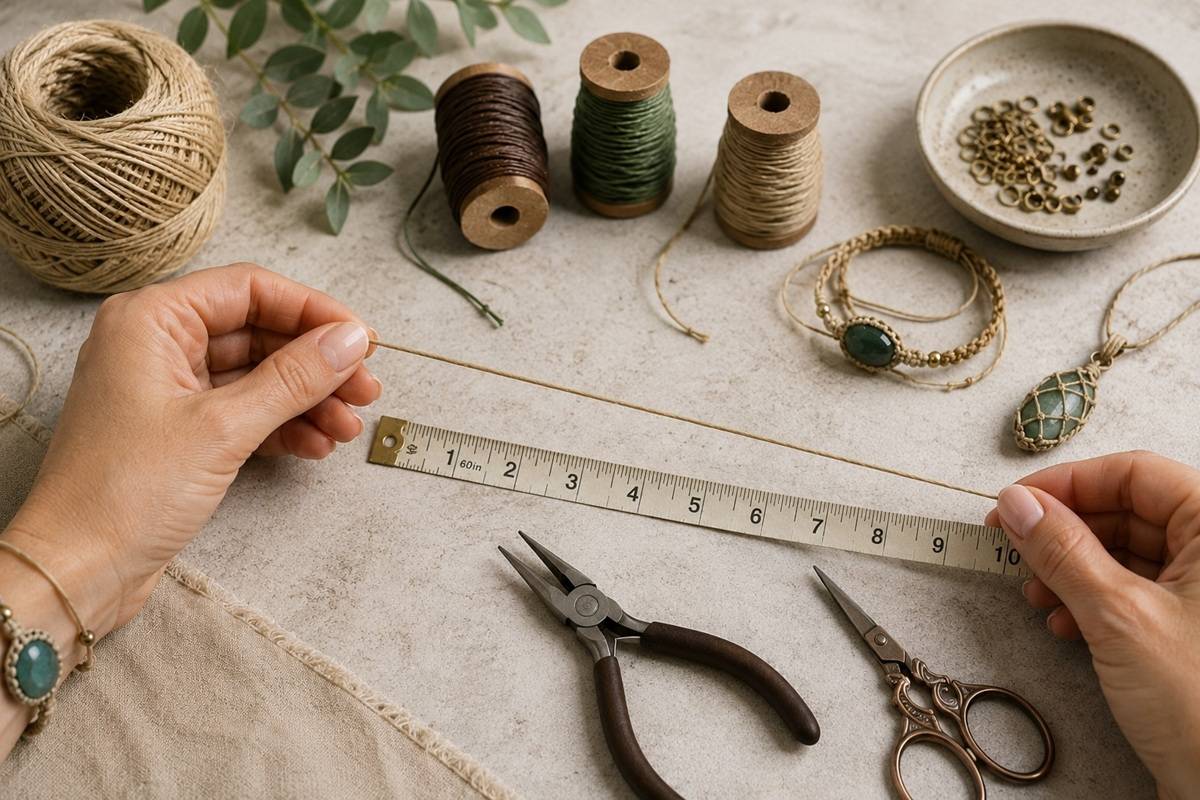
Getting the cord length right matters for bracelets, necklaces, anklets and handmade jewelry. Cut the cord too short, and you may not have enough room for knots, beads or closures. Cut too much, and the extra length can get in the way while you work.
This jewelry cord length calculator helps estimate how much cord to cut based on project type, finished size, closure style, bead use, cord thickness and number of strands.
Table of Contents:
How Much Cord Do You Need for Jewelry?
Typical Cord Length by Jewelry Type
Why Jewelry Cord Length Is Not One-Size-Fits-All
How the Jewelry Cord Length Calculator Works
What Cord Thickness Should You Use for Jewelry?
Recommended Cord Types for Jewelry Projects
What Affects Jewelry Cord Length?
Common Mistakes When Cutting Jewelry Cord
How to Estimate Jewelry Cord More Accurately
Jewelry Cord Length Calculator
Estimate how much cord to cut for bracelets, necklaces, anklets, knots, beads and adjustable closures.
Estimated Cord Needed
Cut length per strand—
Total cord needed—
Total in feet—
Estimated Allowance Breakdown
Closure allowance—
Knot/design allowance—
Bead allowance—
Recommended Cord
—
This calculator gives a practical estimate. Actual cord use may vary depending on knot tension, bead spacing, closure style, cord thickness and design changes. Cut slightly more when testing a new pattern.
How Much Cord Do You Need for Jewelry?
The amount of cord you need depends on the finished size of the jewelry and how much extra length is required for knots, closures, beads or braiding.
As a general rule:
simple bracelets need less extra cord
adjustable bracelets need more cord for sliding knots
necklaces need extra length for closures or pendants
friendship bracelets and macrame jewelry need longer working lengths
multi-strand designs require more total cord
The calculator gives two useful numbers:
cut length per strand
total cord needed for the project
This is more helpful than finished jewelry length alone because most jewelry projects require extra working cord.
Typical Cord Length by Jewelry Type
Use this chart as a quick starting point before using the calculator.
| Jewelry Type | Typical Cord to Cut |
|---|---|
| Simple bracelet | 20–30 in |
| Adjustable bracelet | 30–40 in |
| Friendship bracelet | 50–80 in |
| Macrame bracelet | 40–80 in |
| Anklet | 20–35 in |
| Simple necklace | 24–36 in |
| Pendant necklace | 30–50 in |
| Adjustable necklace | 36–60 in |
These are general ranges. Knotting, closure type, bead size and cord thickness can change the final amount.
Why Jewelry Cord Length Is Not One-Size-Fits-All
Two bracelets with the same finished size may need very different cut lengths.
For example, a simple clasp bracelet may only need a few extra inches beyond the wrist size. An adjustable bracelet with sliding knots may need several extra inches on each side. A friendship bracelet or macrame bracelet may need much longer cords because knots consume material as you work.
Cord length changes based on:
finished bracelet or necklace size
number of strands
knot style
closure type
bead placement
cord thickness
extra working room
That is why a calculator is more useful than a fixed size chart.
How the Jewelry Cord Length Calculator Works
The calculator starts with your finished jewelry size, then adds extra length for construction.
It accounts for:
It accounts for:
project type
closure type
bead use
number of strands
cord thickness
safety buffer
Formula:
Cut length = finished size + closure allowance + knot allowance + bead allowance + safety buffer
Cut length = finished size + closure allowance + knot allowance + bead allowance + safety buffer
For multi-strand projects:
Total cord needed = cut length per strand × number of strands
This gives a practical estimate before you start cutting.
Bracelet Cord Length Guide
Bracelet projects are one of the most common reasons people need a cord length calculator.
Simple Bracelet
A simple bracelet with a clasp usually needs the finished wrist size plus extra cord for knots and finishing.
Typical cut length:
20–30 inches per strand
20–30 inches per strand
Adjustable Bracelet
Adjustable bracelets need more cord because sliding knots require extra working length.
Typical cut length:
30–40 inches per strand
Use more if the bracelet has multiple sliding knots, beads or braided sections.
Typical cut length:
30–40 inches per strand
Use more if the bracelet has multiple sliding knots, beads or braided sections.
Friendship Bracelet
Friendship bracelets require longer cords because the pattern is created through repeated knotting.
Typical cut length:
50–80 inches per strand
Use longer cords for wider bracelets, more colors or dense knot patterns.
Typical cut length:
50–80 inches per strand
Use longer cords for wider bracelets, more colors or dense knot patterns.
Macrame Bracelet
Macrame bracelets use more cord than simple string bracelets because knots shorten the working strands quickly.
Typical cut length:
40–80 inches per strand
If your pattern has many square knots, spiral knots or decorative sections, add extra.
Typical cut length:
40–80 inches per strand
If your pattern has many square knots, spiral knots or decorative sections, add extra.
Necklace Cord Length Guide
Necklace cord length depends on the finished necklace style and how the ends are secured.
Simple Necklace
A simple necklace with a clasp usually needs the finished necklace length plus a few extra inches for knots or findings.
Typical cut length:
24–36 inches per strand
Typical cut length:
24–36 inches per strand
Pendant Necklace
Pendant necklaces need extra allowance for tying, wrapping or securing the pendant.
Typical cut length:
30–50 inches per strand
Typical cut length:
30–50 inches per strand
Use more if the pendant has a wrap, bail, sliding knot or decorative knotting.
Adjustable Necklace
Adjustable necklaces need more cord because sliding knots require overlapping ends.
Typical cut length:
36–60 inches per strand
Typical cut length:
36–60 inches per strand
This is especially useful for handmade hemp necklaces, leather cord necklaces and casual pendant designs.
What Cord Thickness Should You Use for Jewelry?
Cord thickness affects the look, flexibility and structure of your jewelry. It also affects whether the cord will fit through beads or findings.
| Cord Size | Diameter | Recommended Uses |
|---|---|---|
| #10 Hemp Cord | 0.5mm | beadwork, micro macrame, friendship bracelets, fine detail |
| #20 Hemp Cord | 1mm | bracelets, necklaces, adjustable jewelry, everyday designs |
| #48 Hemp Cord | 1.8mm | chunky bracelets, pendants, statement jewelry, macrame jewelry |
0.5mm Cord
Use 0.5mm cord for fine jewelry, beadwork and detailed knotting. It works well when you need the cord to pass through smaller beads or create delicate patterns.
Use 0.5mm cord for fine jewelry, beadwork and detailed knotting. It works well when you need the cord to pass through smaller beads or create delicate patterns.
1mm Cord
Use 1mm cord for most bracelets and necklaces. It is a strong middle option for adjustable jewelry, beginner projects and everyday handmade pieces.
1.8mm Cord
Use 1.8mm cord for bolder jewelry, larger beads, rustic pendants and thicker bracelets. Make sure beads and findings have holes large enough for the cord.
Recommended Cord Types for Jewelry Projects
Hemptique’s jewelry making collection includes natural cord options for different styles and techniques.
Hemp Cord
Hemp cord is one of the most useful options for handmade jewelry. It holds knots well, has a natural texture and works for bracelets, necklaces, anklets and macrame jewelry. The most common jewelry sizes are:
#10 hemp cord – 0.5mm
#20 hemp cord – 1mm
#48 hemp cord – 1.8mm
Linen Cord
Linen cord is a good choice for jewelry that needs a crisp, structured look. It works well for clean knotting, pendants and natural fiber designs.
Cotton Cord
Cotton cord is soft and flexible, making it useful for casual bracelets, beginner projects and designs where comfort is important.
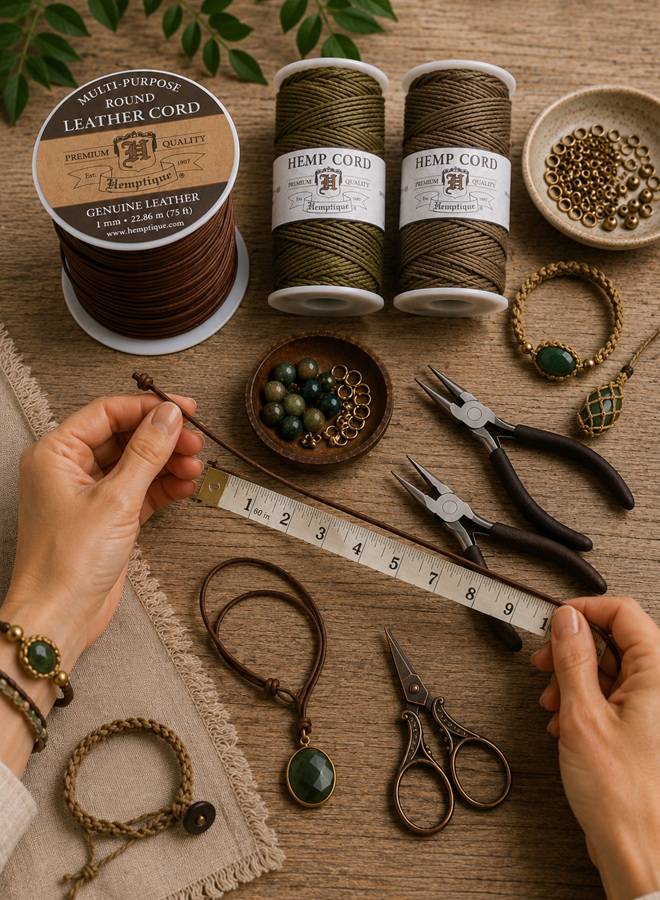
Leather Cord
Leather cord works well for pendant necklaces, wrap bracelets and rustic jewelry. It gives designs a stronger visual weight and pairs well with metal, wood or stone accents.
What Affects Jewelry Cord Length?
Closure Type
Closures can change the amount of cord you need.
| Closure Type | Extra Cord Needed |
|---|---|
| #Clasp | Low |
| Tie-on ends | Medium |
| Sliding knot | High |
| No closure | Low |
| Stretch style | Medium |
Sliding knots usually need the most extra cord because the ends must overlap and move smoothly.
Knots
Knots consume cord. The more knots in your design, the more cord you should cut.
Common high-usage designs include:
friendship bracelets
macrame bracelets
spiral knot bracelets
sliding knot closures
wrapped pendants
Sliding knots usually need the most extra cord because the ends must overlap and move smoothly.
Beads
Beads can reduce or increase cord usage depending on the design.
fully beaded designs may use less knotting cord
knotted bead spacing uses more cord
large beads require thicker cord and more spacing
small bead holes may require thinner cord
Always check bead hole size before choosing cord thickness.
Number of Strands
A two-strand bracelet needs twice the cord of a single-strand design. A four-strand friendship bracelet or macrame bracelet needs more total cord even if each strand is the same cut length.
Common Mistakes When Cutting Jewelry Cord
Cutting only the finished size
A 7-inch bracelet does not need only 7 inches of cord. You need extra for knots, closures and working room.
A 7-inch bracelet does not need only 7 inches of cord. You need extra for knots, closures and working room.
Forgetting sliding knot allowance
Adjustable bracelets and necklaces need longer ends so the knots can slide properly.
Using cord too thick for beads
Always check bead hole size before cutting. Thicker cord may not fit through smaller beads.
Ignoring knot density
Friendship bracelets and macrame jewelry use more cord because knots shorten the strands.
Not cutting enough for multiple strands
Always multiply the cut length by the number of strands.
Skipping a test knot
Before cutting all your cord, test one knot or bead section to see how much material it uses.
How to Estimate Jewelry Cord More Accurately
Use this process:
Measure the finished bracelet, necklace or anklet size
Choose the closure type
Decide if the design uses beads
Choose the cord thickness
Count the number of strands
Add extra for knots and working room
Cut slightly more than the estimate when testing a new design
For detailed knotting or a new pattern, test a small section before cutting all cords.
Related Craft Calculators
Planning other fiber projects? These calculators can help:
They work well alongside this jewelry cord calculator if you make mixed craft projects or switch between jewelry, yarn and macrame designs.
Explore Hemptique Jewelry Making Supplies
Once you know how much cord to cut, choose the cord type that fits your project style.
For fine beadwork and friendship bracelets, #10 hemp cord offers a thinner 0.5mm profile. For everyday bracelets and necklaces, #20 hemp cord offers a balanced 1mm size. For chunkier bracelets, pendants and macrame jewelry, #48 hemp cord gives more texture and visual weight.
Hemptique also offers linen, cotton and leather cords for jewelry makers who want different textures, finishes and project styles.
FAQ
How much cord do I need for a bracelet?
How much cord do I need for an adjustable bracelet?
Most adjustable bracelets need around 30–40 inches per strand because sliding knots require extra overlap and working room.
How much cord do I need for a necklace?
A simple necklace may need 24–36 inches per strand. Pendant necklaces and adjustable necklaces may need 30–60 inches depending on the closure and design.
What size cord is good for bracelets?
For most bracelets, 1mm cord is a practical starting point. Use 0.5mm for beadwork and fine detail, or 1.8mm for chunkier bracelet styles.
What size cord is good for necklaces?
For pendant necklaces and simple cord necklaces, 1mm cord works well. Use 0.5mm for delicate designs and 1.8mm for rustic or statement necklaces.
How long should bracelet string be?
Bracelet string is usually much longer than the finished bracelet size. A 7-inch bracelet may require 20–40 inches of cord depending on knots, beads and closure style.
Does bead size affect cord length?
Yes. Large beads, knotted bead spacing and bead hole size can all affect how much cord you need and what thickness will work.
How much cord do I need for macrame jewelry?
Macrame jewelry often needs 4–8 times the finished length, depending on knot density and design style. For detailed macrame bracelets, cut extra to avoid running short.